

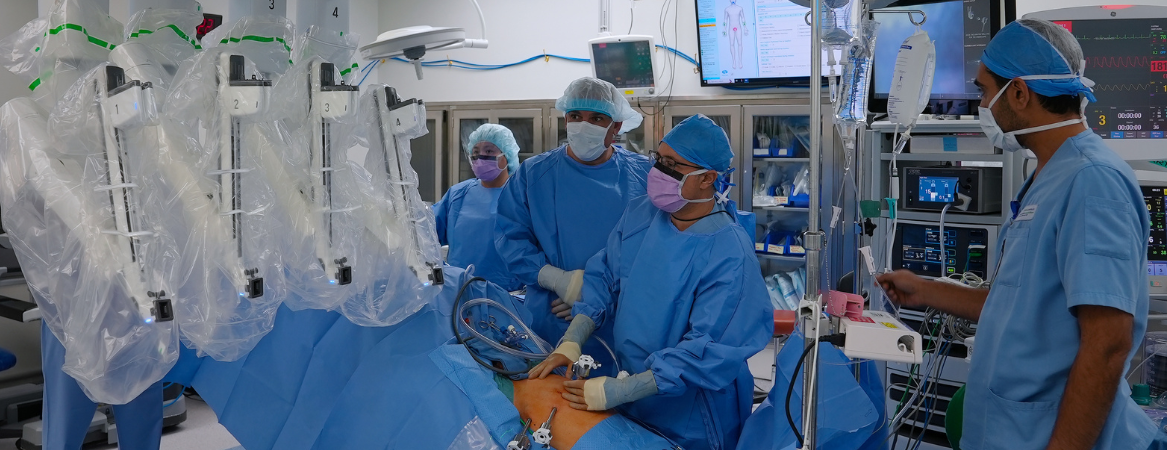
Cutting-edge endoscopic and diagnostic technology help Johns Hopkins Aramco Healthcare’s gastroenterology unit to dramatically reduce patient wait times
Average wait for routine gastrointestinal services reduced from eight weeks to one after new technology and advanced minimally invasive techniques introduced.
Gastroenterology patients at Johns Hopkins Aramco Healthcare are undergoing routine endoscopy within a week of diagnosis, and minimally invasive surgery within two weeks, after a technology transformation project dramatically reduced wait times.
The project — which involves the introduction of advanced diagnostic and therapeutic endoscopy, new diagnostic techniques, and several new services — has also led to shorter inpatient stays and a huge reduction in referrals to external providers.
The transformation project, which covers both outpatient and inpatient gastroenterology services, aims to boost the capacity, efficiency, and safety of Johns Hopkins Aramco Healthcare’s gastroenterology services. The project has exceeded international quality metrics as well as Johns Hopkins Aramco Healthcare’s own targets.
“These advancements underscore our dedication to providing cutting-edge, patient-centered care,” Dr. Nassir Al Hayaf, Chief of Specialty Medicine at Johns Hopkins Aramco Healthcare, said. “By enhancing diagnostic capabilities and reducing referrals, we are transforming the healthcare experience for our patients and their families.”
A key driver of the success of the gastroenterology unit transformation project is the introduction of state-of-the-art technology that allows advanced diagnostic and therapeutic procedures to be undertaken in-house. These technologies include:
SpyGlass™ cholangioscopy. A groundbreaking procedure for diagnosing and treating bile duct disorders using a tiny scope.
Single balloon enteroscopy. A minimally-invasive technique for in-depth examination of the small intestine.
Endoscopic ultrasound. High-quality imaging and precise tissue sampling now enable in-house diagnosis of malignancies, replacing the need for external referrals.
Esophageal pH and manometry. Critical procedures for accurately diagnosing esophageal disorders.
The new technology has helped Johns Hopkins Aramco Healthcare clinicians to increase the capacity for diagnostic and therapeutic endoscopic procedures performed at the hospital and improve quality across the board. Advanced endoscopic surgical procedures help patients to recover faster, and with less pain, than traditional open surgery.
In 2024, Johns Hopkins Aramco Healthcare referred 35% fewer gastroenterology cases to external providers compared with 2023, thereby reducing delays and complexity for patients, and improving their experience.
A young mother who underwent evaluation and treatment for a liver transplant at Johns Hopkins Aramco Healthcare said: “Being close to my family made all the difference during my journey.”
Johns Hopkins Aramco Healthcare’s gastroenterology unit has also expanded its capabilities by hiring specialist clinicians and establishing new clinics. For example, Johns Hopkins Aramco Healthcare now has a board-certified hepatologist who specializes in liver transplants, and a dedicated hepatology clinic for patients with complex liver diseases and transplant needs. This has enhanced the service offered to all patients, and especially patients who have had or require liver transplants.
The gastroenterology unit is in the process of further enhancing its diagnostic capabilities. It will soon offer pH monitoring with the minimally invasive Bravo capsule, a device that attaches to the esophageal lining and wirelessly transmits pH data for up to 96 hours. It has also installed the latest cutting edge FibroScan machine, which assesses fibrosis and cirrhosis using non-invasive ultrasound technology, preventing the need for a liver biopsy in many cases.
Learn more about gastroenterology services at Johns Hopkins Aramco Healthcare.
More News
All News
07 Jul, 2026
Two Births in One Day
A rare complication stopped Hasna's heart moments after her daughter was born. The Johns Hopkins Aramco Healthcare team that brought her back gave her family a second birth: her own.

05 Jul, 2026
Johns Hopkins Aramco Healthcare Expands Access to Specialized Therapy with New Rehabilitation Center
The new Rehabilitation Center features advanced technologies that improve privacy, capacity and patient recovery.

30 Jun, 2026
Global Top 3% Ranking for KLAS Pinnacle Award
Johns Hopkins Aramco Healthcare earned a top 3 % global ranking in clinician EHR experience, reflecting strong satisfaction and excellence.